Saturday, February 12, 2011

Beaver Restoration in New York

In the early 1900s the State of New York began restoring beavers in the Adirondacks, the state's principal wilderness area that fills most of the northeast section of the state. In 1910 the Adirondacks included between 5000 and 6000 square miles of mostly forested mountains, lakes, plateaus, but villages, sawmills and mines as well. By then it had been settled with about 100,000 permanent residence and timber and mineral resources had been tapped for a century. Most of the report just pinpoints where beavers have been seen. I hope to include maps soon so better sense can be made out of the spread of the beavers from 1905 to 1914, but there is a poetry in all the names of lakes and streams, for anyone who likes beavers.


from State of New York

Fourth Annual Report of the Conservation Commission 1914

Return of Beavers to the Adirondacks

The beaver has been restored to his favorite haunts, the Adirondacks, by means of restocking and effective protection, according to the reports of systematic observations of protectors and others received by the Conservation Commission. These investigations show that there are to-day between 1,500 and 2,000 beaver in the wilds, which the Iroquois Indians called "Koh-sa-ra-ga," "The Beaver-Hunting-Country," and whose ownership was challenged by the Canadian tribe, styled in derision by the Mohawks, the "Adirondacks," the "Tree Eaters."

The Adirondacks to-day are again entitled to their old Iroquois name, for they are rapidly becoming the country of the Beaver, although this favorite fur bearing animal is no longer persecuted by the trapper and hunter.

The Legislature of 1903 appropriated $500 to begin the restocking of the Adirondacks with beaver and in 1905 three pairs were liberated. One pair were given their liberty on a small stream entering the south branch of Moose river, where another beaver which had escaped from the Woodruff preserve had built a dam. The other four were liberated on the northeast inlet of Big Moose Lake, but moved over into Beaver river, twenty miles ot the northeaast, to being housekeeping. During 1905 Edward H. Litchfield liberated about a dozen beavers in his preserve near Big Tupper Lake, and several of these escaped into adjoining preserves.

In 1905 there was reported to the Fish and Game Commission the existence of a "small native colony of beavers, the last of the remnants of the original stock, inhabiting the waters northwest of upper Saranac Lake." That year the Commission placed a "conservation estimate of the beaver in the Adirondacks" at "about forty." (p 252)

In 1906 the Legislature appropriated $1,000 for continuing the restocking of the Adirondacks with beaver and the following year seventeen were obtained from Yellowstone Park and distributed. The Commission gave the beaver census that year at 100.

In 1904, about the time the State of New York began its work of restoring the beaver to his native habitat, an authority on "American Animals" recorded in his book the sad fact that "the beaver is now nearly extinct in the United States." Much general interest has been displayed in the work of restoration in this State and the Conservation Commission is happy to say that popular co-operation has made the task of protecting Castor canadensis a comparatively easy one .

The reports received by the Conservation Commission show that beaver are multiplying rapidly and are taking possession of their ancient heritage in many different sections of the Adirondacks.

Colton District. Protector Smith of Colton reports three colonies in his territory of the Raquette river country.

Cranberry Lake District. Protector Hand of Cranberyy Lake records 1 colony on Grasse river below the reservoir; 1 colony on Cranberry Lake Inlet; 1 colony on Bog river; and "signs in the Town of Webb."

Croghan District. Protector Andre of Croghan reports 2 colonies at Sunday Lake; 1 at Stillwater, Beaver river; 1 at Francis Lake; 1 at upper end of Watertown Light and Power dam; 2 on west branch of Oswegatchie river. All "good sized colonies with large houses." Also a few beaver scattered in various places, without permanent habitat as yet.

Forestport District. Protector Bellinger of Forestport reports 3 colonies on the Black river; 1 at Kayuta pond; 1 three miles above Enos where they have built a dam; 1 on the Stillwater below North Lake; 1 colony on north branch of North Lake; 1 colony on second Stillwater above Honondaga Lake on West Canada Creek; several colonies on Indian river. Also reported by protector Ball, 1 colony on Wintime pond; 1 on Little Black Creek; 2 on Twin Lakes streams; 3 on Big Woodhull streams.

Fulton Chain District. Protector Ball of Old Forge enumerates and locates no less than 79 colonies, with 76 dams, inhabited by 223 beaver. The beaver locations in Ball's district are: Old Forge Pond, Big Spring Creek, First Lake and marshes, Second Lake, Third Lake, Fourth Lake, Fifth Lake, Sixth Lake, Seventh Lake, Eighth Lake, Cedar Creek, Black Mt. Creek, Eagle Creek, Limekiln Creek, Red river, Indian river (mostly bank beaver), Nick's Lake, Dry Lake (not dry now, flooded by beaver), Moose river (bank beaver), Hellgate Creek, Indian Spring Creek, Inlet of Big Otter, North Branch above Fulton Chain, Rondax Lake, Snake Pond, Chub Pond, Constable Pond, Queer Lake, south and west branches Beaver river.

J. Gilbert Hoffman, of Fulton Chain, finds that the beaver are increasing rapidly in various sections he has visited. He found a colony at Red Horse Chain and others reported by protectors. In that territory the intelligent animals have apparently lost most of their natural fear of man. A beaver dam on Eagle Creek which caused the flooding of the highway, was torn down under the direction of Protector Ball. The beaver reconstructed the dam over night. In another interesting case, the beaver insisted on invading Dr. Nicholl's property on First Lake. Protector Ball placed a lighted lantern in a lodge of the intruders, but they refused to take the hint to move on and, industriously extended their lodge over and around the warning beacon. Then in order to circumvent the trespassing beaver, the men put up a wire fence so the beaver could not get into Nicholl's yard where they were cutting poplars for food. Thereupon the wily animals vindicated the assertion of a scientist who said that "beaver apparently (sic) depend more upon reason and less upon instinct than do the majority of the forest folk." They piled wood against the fence and easily climed (sic) over into the forbidden territory.

Mr. Hoffman says the Brown's Tract Lumber Company is glad to see the beaver restored to the Adirondacks. In his opinion they do no great damage except in rare cases where they become so tame as to invade summer camp groves.

Glenfield District. Protector VerSnyder of Glenfield reports the beaver numerous in his section: 1 colony at Mud Hole Pond; 1 at Little Pine Lake; 1 on Pine Creek; 1 on Crawford's Fish Pond. Protector Quirk of Pulaski reports that he has not learned of any beaver in Oswego County. He has information of 1 colony on Crooked Creek, Lewis County, one mile from the south end of Stoney Lake, and 1 colony east of the north end of Stoney Lake in Independence river.

Gloversville District. Protector Masten reports that "the beaver made several visits to Fulton County," but founded no permanent colonies. It is possible that the few beaver in that section are "bank dwellers," as the animals, when disturbed by or not yet accustomed to civilization, do not build lodges.

Keene District. Protector Seckington, Elizabethtown, reports in September a beaver colony at Hull's Falls, town of Keene. On December 10 he reported discovering a new colony which has constructed a dam about 75 feet long, and flooding about 25 acres, on Gates Brook. The animals have built a lodge 15 feet in diameter accommodating 10 to 12 beaver.

Lake Pleasant District. Protector Howland of Speculator, reports very numerous in his territory: On Miami river, two dams with at least 20 beaver at each, and a third dam building in September on that river; 1 colony on Mill Brook; 2 large dams on Whitney Creek. To support the first dam, the beaver have built a dam half a mile below, backing up the water to it that distance. The first dam floods the stream one mile. One small colony on Mosey Fly stream. One large dam on outlet of Spencer Lake, with back water of two miles, inhabited by at least 200 beaver. Large colony and dam on north branch of Sacandaga river, with 30 to 40 inhabitants. Beaver in September were building a new dam on Samson Lake outlet and colony is established there.

Long Lake District. Protector Butler of Long Lake reports at least 30 beaver in his section. He makes this observation of special interest to the trout anglers: "The people living in this section think the beaver are doing fine and are glad to see them back. They tell me the beaver are a protection to our small streams containing trout, because the beaver builds dams and flood the marshes back of the dams. This makes it hard for the fishermen to fish all the pools and gives the trout a chance to grow."

Newcomb District. Protector Bissell of Newcomb reports 2 large colonies in the town of North Hudson; 1 colony in the town at Minerva and 4 colonies in the town of Newcomb.

Plattsburgh District. Protectors North and Kirby report from Plattsburgh that they found a "good sized colony" of beaver on Smith's Kiln Brook, town of Saranac, Clinton country. The animals have built a dam 35 feet long, flooding an acre.

Protector Riley of Plattsburg learned that the colony which had established itself near the mouth of the Ausable river last spring had moved up near Ausable Forks.
Protector Kirby of Brainardsville makes report of a colony on Redford Brook.

Raquette Lake District. Protector Lynn of Raquette Lake makes a detailed report of numerous colonies in his territory, showing over 250 beaver inhabitants. His record of locations is as follows: In Township 40, colonies on Bowlder Brook; 1 on Beaver Brook; 1 on Otter Brook; 2 on Brown's Tract Inlet; 1 on Brandeth Lake stream; 1 on Marion river. In Township 41, 1 colony on Cascade Lake stream; 1 on Shallow Lake stream; 1 on Cranberry Pond; 1 on Eagle Creek; 2 on Two Sisters Pond. In Township 39, 2 colonies on north branch of Shingle Shanty stream; 1 on East Pond. In Township 36, 1 colony on Big Salmon Lake; 1 on Carey Pond; 1 on Rack Pond stream; 1 on Flat Fish Pond; one on Bottle Pond stream. In Township 35, 1 colony on Loose Pond stream; 2 on North Bay Brook, Forked Lake; 1 on Upper Sargeant Pond. In Township 34, 2 colonies on Utawanta Lake; 1 on Loon Brook. In Township 6, 1 colony on Marion river; 2 on South Inlet; 1 on Bear Brook. In Township 5, 1 colony on Brown's Tract Pond. In Township 3, 2 colonies on Hess Pond; 1 colony on Fifth Lake; 1 colony on Seventh Lake; 2 colonies on Red river. In Township 4, 2 colonies on Falls Pond; 2 colonies on Mitchell Pond; 1 on Summer Creek; 2 on Indian river.

St. Regis District. William Bump, a caretaker of the Brooklyn Cooperage Company's tract on the St. Regis river, reports the beaver becoming quite numerous around the Ten Mile. Henry House of the Five Mile Camp, St. Regis river, found several families of beaver on Alder Brook.

Wednesday, December 29, 2010

Lachine Fur Trade Museum

I visited the Fur Trade Museum in Lachine, Quebec, at the up river edge of Montreal. The historical core of the exhibit is a mixture of portraits, maps, tables and generous examples of dressed furs and beaver felt hats. There was one mounted beaver, a juvenile with summer fur, just the kind not prized by the fur trade.


Then there were several large, strangely dressed, plush beavers, with exaggerated white incisors, placed on pedestals or barrels around the displays to serve as "guides" to the exhibit.


There were also exaggerated plush human figures including a French Canadian "habitant" carrying a pack of beaver skins, dressed a bit like that first plush beaver.


and two merchants fighting over a beaver skin.


A plush beaver nearby, dressed a bit like a merchant, held a placard saying: "Merger or no merger, they are still after my hide!"


Museums in Quebec have a different style, a flare that is often lacking in American and other Canadian museums, but I thought this went too far and I challenged the attendant, asking him if his museum was "serious." He explained that the museum's prime audience was school children and that the exhibit has not been changed since the mid-80's, implying that back then there was an antic streak in the design of Quebec museum displays.

Perhaps that is a sufficient explanation, but I found out later that a scholarly conference on the fur trade was held in the Montreal area 1984 so perhaps the museum's exhibit was one of the collateral activities that sometime accompany conferences. If you think that a "scholarly" conference would be too serious to deign to visit such a museum show, then you have never been to a "scholarly" conference.

The conference itself wasn't held in this rather small warehouse which indeed is a faithful renovation of the principal depot for furs coming down the St. Lawrence and Ottawa rivers.


Usually every Scottish name you bump into in Montreal, like McGill University or the McCord Museum, is associated with the fur trade. But those downtown institutions didn't host the conference. It was held at the Lake Saint Louis Historical Society which is a bit up river from Lachine. A tourist in Montreal proper can get an impression that the city has scant interest in the fur trade even though English speaking North Americans think the fur trade was the sole basis for the establishment and growth of Montreal.

That all the great names in the city from the fur trade are of English speakers probably lessens the interest of the modern francophone establishment in Montreal for any celebration of the fur trade. The French names associated with the trade are connected in many other ways to the growth of the city. And as I learned from reading the proceedings of the conference at Lac Saint Louis, the principal historian of the Montreal economy prior to the British takeover in 1763, Louise Dechene, contended in a 1974 book published in Paris, that the fur trade was of marginal importance for the growth of Montreal.

For English Canadians the fur trade is the first thread that links their country together from sea to sea. To be sure French Canadians served the English in all their fur trade exploits from sea to sea, but before 1763, the thrust of French colonization was through the Great Lakes and then down the Mississippi to the Gulf of Mexico. So why shouldn't Montreal have a bit of plush fun at the expense of the dignity of a trade that made a lot of British merchants in Montreal rich?

While the plush figures at the Lachine Museum have fun at the expense of beavers, French Canadians and English merchants, the plush figures of Indians are imbued with as much dignity as plush figures can convey. An Indian man stands with more dead animals in hand, and an Indian woman dresses fur at his feet. The Indians are dressed as if they live in the arctic, even though furs from that region never came through Lachine.


But that's quibbling. Who's to say that in the course of the unprecedented slaughter of millions of animals that there were not domestic scenes like this. But why were the Indians the only plush figures accorded some respect?

In his introduction to the published proceedings of the 1984 scholarly fur trade conference held near the museum, the late Bruce Trigger, a highly respected Canadian anthropologist, alluded to a memorable program in which conference participants joined the aboriginals living near Montreal, Mohawks of the Kahnawake reserve along the south shore of the St.Lawrence. Trigger didn't go into detail, but left the impression that the Indians insisted in no uncertain terms that they wanted aboriginal participation in the fur trade addressed respectfully.

When I moved to the St. Lawrence River valley in 1994 and began watching beavers, I sought the guidance of the local state wildlife biologists who gave me a recently published study about beavers along the river. It didn't give me much information about beavers but it did provide a long analysis of what "stakeholders" along the river thought about beavers based on opinion surveys of the stakeholders. As I recall, farmers, foresters, transportation officials, homeowners, and hikers were considered to have a stake in the management of beavers. As I've been learning ever since, beavers are not stakeholders in this debate. The fur trade exhibit at Lachine reminded me that there are stakeholders in history.

Judging from this display Montreal and Quebec have more or less given up their stake in fur trade history, as have the families of the great Scottish fur merchants. But not the Indians. So there is something to be learned in this visual burlesque of the fur trade. A cursory view of the centuries of the trade suggest that the decline and disappearance of most Indian tribes in North America was tied to their participation in the fur trade, and one would think that Indians, of all people, would want to forget it. Of course, I have no idea if Indians influenced how they are displayed in the museum. More likely an anthropologist sensitive to the feelings of Indians made sure that a big nosed, slack jawed half naked brave was not on display being taunted by a plush beaver wearing a war bonnet.

Indeed anthropologists today often earn their advanced degrees doing field work with arctic tribes where the hunting and gathering culture persists. Because of that, I am a bit suspicious of what anthropologists write about the fur trade. The material culture uncovered by anthropologists is germane to any historical discussion, but the analysis of anthropologists has to be evaluated carefully. A mutual dependence has grown between anthropologists and the Indians they study, and they both seek to encapsulate, not an episode in the past, but a way of life, with either scientific or mythological trappings. It's bad news for beavers if their slaughter is considered a timeless part of the identity of any segment of contemporary society, or any stake holder in writing the history of the fur trade.

So I benefited from visiting the museum. It reminded me of how important it is that we began to try to write a new history of the fur trade from the beavers' point of view.

Monday, November 15, 2010

Indian Mounds and Beavers


I've just completed an inspection of the major southeastern Indian mounds and took another look at the Newark, Ohio, earthworks supplementing a tour I took of the Ohio Indian mounds two years ago. These mounds were all built before contact with Europeans and when I looked at them I tried to sense any influence beavers might have had in inspiring and informing their construction.


I want to figure out, as best I can, what relationship beavers had with North Americans before the influx of Europeans and the fur trade between North America and Europe. My working hypothesis is that beavers were unimportant to Indians before the fur trade, as befits an interesting but uncharismatic small mammal.


Of course, I was only able to approach these sights as a tourist with map and on-site brochures in hand, followed by a tour of attendant museums when possible. After I saw the Newark earthworks, I bought the catalog of the recent Field Museum show on pre-contact Indian art, Hero, Hawk, and Open Hand. Although all these mounds were probably central to the ceremonies of those who built them, there are few tourist sites less ceremonial than these. Cut green grass covers all, and there is no statuary or stonework, no piles of bare dirt, which was the principal building material for the mounds. One can climb the mounds but trees usually obscure the view. I imagine that the Indians who built them and lived with them when they had meaning would be thoroughly dispirited at seeing them today. They remain interesting but not magical, and bleed none of the sweat that must have gone into the building them.

Yet I when I first walked around the earthworks in Newark, Ohio, I was thoroughly entranced, though not with the spirit of the ancient Indians. I was entranced with the spirit of beavers! For the past 16 years, I've watched the slow evolution of beaver ponds, lodges, dams, canals.


What I saw at Newark was a perfectly circular embankment save for a wide opening facing toward the river that ran through the middle of the town a half mile away.


In the center of the embankment were two small rounded mounds that presented the same silhouette as a beaver lodge but nothing more, no logs, rocks, mud, the materials beavers use to make their lodges. So I suppose what gave me a sense of the spirit of beavers was the proportions, the empondment of space, to coin a word, with a central focus.


The proportions were not perfect. The central mounds were dwarfed by the embankment and beaver lodges generally dominate the flats created by beavers with their dams and canals.


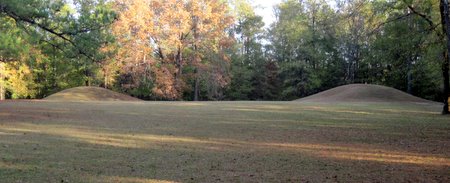
The next mounds I visited at Chillicothe, Ohio, requited my yearning for a dominating central focus. The central mound dwarfed the surrounding embankment.


I saw two other mound complexes on that first trip, a very large isolated mound, and earthworks shaped like a serpent placed up on a high hill looking down at a river, not on a flat like that other mounds.


I didn't take the two photos above. It was raining the day I visited.

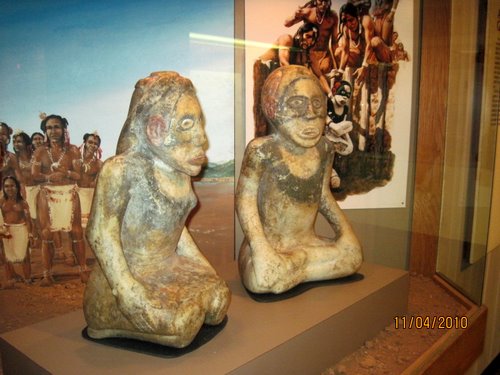
There is a museum at the Chillicothe site dedicated to the Hopewell Indians who made the mounds and their art and artifacts. There was a three inch long stone pipe shaped like a beaver,


and that was the only evidence that the Indians had any non-utilitarian interest in the animal that inspired my enchantment with the mounds. All Indian cultures seemed to use the beaver's giant incisors as a cutting tool.


The didactic displays at the museum made clear that the mound-making culture flourished because growing corn fostered a large sedentary population. Here were farmers who were not dependent on animals for food, nor was there evidence that they needed them for clothing, though, to be sure, deer antlers and hides as well as bear claws and robes fascinated them.

It seems to me that it does not necessarily follow that if the beaver inspired the Hopewell Indians to build mounds that they would then deify beavers or exalt them in their art and artifacts. Unlike bears, serpents and large birds of prey, beavers are not terrifying. They change the landscape but not by any magical means; nothing is plainer than how they go about their business.


One doesn't need a high priest to explain the beavers' ways to man. However, there is another problem with my thesis. Where there was a mound building culture, in the Mississippi and Ohio river valleys, there were beavers, but farther to the north around the Great Lakes and the St. Lawrence River valley, where I live, beavers dominated the landscape far more and there the Indians were not great mound builders. Farther to the north, there was less dependence on corn, and, since it is more a land of lakes, less inundation by flooding rivers.

One can't visit the mounds without getting a sense that one convenience of having them was as a place of refuge during a flood. A friend lived in a dorm near one in Marietta, Ohio, and when there was a flood inundating parts of the campus, the 40 foot high Indian mound remained high and dry. Perhaps not enough room for a crowd but room enough to keep a king or his buried bones dry.


Beavers provide an on-going demonstration of how to find a dry berth as they managed their controlled floods that let them expand their foraging of trees for the bark food and building materials.

More problematical to my beaver-sense of the mounds, was the obvious ceremonial importance of them, especially when I read about the mounds farther south in Georgia, Alabama, and Mississippi. The art I saw associated with the Hopewell Indians reminded me of Aztec and Mayan art. How could beavers compete with the advanced civilizations radiating up from the cradle of corn culture in Mexico whose large stone ceremonial structures dominating their plazas still remain?


In early November we got an invitation to spend some time in Birmingham, Alabama, and I know that modern city was not far from three ancient ones. Of course, the only remnants of those cites were the mounds. At first blush I thought there might be some good mounds in Eastern Tennessee that we could see on our way, but the dams built on the Tennessee River flooded several of them. On our way to the Etowah Mounds in northwestern Georgia my wife insisted that we look at the New Echota Cherokee Capital State Historic Site nearby. There we saw a recreation of the Cherokee capital on the eve of that tribes expulsion in 1830s. There were no mounds between the few rude buildings made of wooden planks but there was a short nature trail which I walked on a damp cool morning and I saw beaver work in some small ponds.


A sign explained that New Echota was one of the lowest points in that neck of Georgia and that just a few months before the whole area had been flooded. Indeed, a visitor to the Cherokee capital in the 1830s reported a flood and that residents went from building to building in boats.

This prologue to my seeing the Etowah Mounds probably disposed me to sense beavers once again as I crossed a bridge over a deep moat and approached the tall mounds.


We reached the mounds just as a field trip of elementary school kids were leaving it. That brought home the massive scale of these mounds


and even though there was a sizable river flowing not far from the two smaller mounds, the mounds were high enough and square enough not to remind me of beaver lodges. There was a good small museum with many of the artifacts found in the mounds, no stone beavers. There were statues that once again reminded me of Mexican art.


A few days later we took a day trip from Birmingham to the Moundville a few miles south of Tuscaloosa and there we saw mounds not quite as high as the principal one at Etowah but there were more of them.


Atop the highest mound looking at several smaller mounds, I had to rather stretch my imagination to see any analogue to the beaver ponds I tour back on a large island in the St. Lawrence River: a beaver lodge sharing a pond with several smaller muskrat lodges?


It was easy to see the point the archaeologists studying this area are making: this was a religious center for a mighty chiefdom to which thousands of people paid homage. Then it became a necropolis.

I was about to put aside my nonsense about beavers influencing mound building, when I saw a plaque describing a structure the archaeologists think was built on large rectangular mound no more than three feet high that stretched out beside the tallest moundt. They found evidence of a large lodge built around wooden posts with a rounded shape,


which, of course, reminded me a beaver lodge.


However, these mounds are situated in a loop of the Black Warrior River which seemed to have cut a pretty good canyon suggesting that the area was not that prone to flooding.


Beavers here would have bank lodges fashioned with logs shielding burrows into the river bank.


The museum at the site was very good with some prime examples of Mississippian Indian art. Those pieces were bit off to the side and the center of museum catered to the imagination of younger visitors with dioramas of Indian ceremonies. Although none of the archaeological notes I read mentioned costumes of fur, the dioramas made lush use of them.


Fortunately, the mannikin Indians were in climate controlled cases and didn't have to sweat the heat of central Alabama burdened with furs. I saw a bear, raccoons, bobcats, various mustelids along with deer hides, but no beaver fur. Then that beaver chord of mine was touched again.

One of the major motifs of Mississippian and Hopewell art in general and Moundville art especially is the open hand motif. Archaeologist think it is based on pattern of stars in the constellation we call Orion which signified the earthly portal that was the entrance to the underworld. It struck me that an open hand is shaped a bit like a beaver's paddle tail. Then on one vase I noticed that there was cross hatching on the arm of a hand, not unlike the cross hatching on a beavers tail.


That said I could also see that there was liberal crosshatching on representations of reptiles and birds, symbols explicitly used by these people. I probably had no business thinking of beavers as having anything to do with it.

At the Moundville visitors center a short film noted that no Mexican artifacts or trade goods had been found in the mound complex. I reserved my intuitive judgment on that until I got to the Emerald Mounds a few hundred miles closer to Mexico not far from the Mississippi River. I had expected to see the mounds on the same bluff overlooking the river that some of mansions of Natchez, Mississippi, are built,


but instead I found them several miles east just off a winding road through some gentle hills. Emerald Mound doesn't look like a beaver lodge at all.


It is more like a football field elevated some 60 feet with two pyramidal mounds for end zones one larger than the other.


I had no sense of beavers here. Thanks to the woods around the mounds I couldn't even tell where the mighty river was much less the nearest. Archaeologists think the mound is an expansion of a natural hill. The Indians buried a hill so to speak letting it form the core of their ceremonial mounds. All the other mounds I had seen had been built from scratch allowing easy burials throughout the mound.

I found that I climbed a pedestal from which I could see nothing, and I didn't have any sense of containment. Something is missing from Emerald Mound and when I tried to let my imagination add to it, I didn't get any sense of beavers. Here were mounds on hills commanding, I guessed, an extensive plain given over to fields of corn. Yes, I can take photos of beaver ponds showing the rounded lodge in a commanding position, but usually the true perspective puts the lodge at the lowest point in a valley, a refuge not a lookout.


Here one could get a sense of the stages of growth and domination. This was not a case of taking some tips from beavers to escape floods, but a celebration of the growth of corn and power. What was I doing when I walked up these mounds but growing and feeling bigger, perhaps too big?

Beavers live inside their lodges. A beaver only walks up to build its lodge or dam. It finds its center when it floats in the magnificent pond it builds. It only climbs the trees it cuts after the tree crashes to the ground. Emerald Mound was the negation of a beaver centric world.

As we headed home I had one more errant theory to test. Looking at photos of mounds, I got the impression that the mounds farther north were more rounded. The Natchez Trace Parkway goes all the way to Nashville (with no stoplights nor billboards) and passes several areas with Indian Mounds. The Trace follows old Indian trails that white pioneers also used as a road south. Of course, white pioneers built all their major cities along rivers. Jackson, Mississippi, is the only large city along the trace until you get to Nashville. As we approached Nashville we kept going down and down and down some more, which impressed on us that the Trace follows a series of hills and high plateaus. It reminded me more of the way otters travel, not beavers. Otters like to claim the high ground and then negotiate a passage from there. I could see why Indians and early pioneers, fearful of ambushes, would do the same.

When we did see some mounds in northern Mississippi, they were indeed rounded like beaver lodges, and as southern Indian mounds go, they were small. One small group had no ceremonial sense about it.


One group that we had to speed by at dusk had several mounds on a flat of which someone could make some sense. There were probably more beavers in these hills then along the bluffs overlooking the Mississippi River. A gift shop made that point by having a beaver pelt among others on display. I also wonder if the dirt closer to the alluvial plains to the south is finer necessitating mounds with a flat top, while dirt in the foothills holds its shape?

I could begin making my own mythology: rounded burial mounds were modeled on the beaver an animal that built mounds and, farther to the north, largely lived in their mounds until the spring until the emerged in the spring as if new born.... Except even in the very cold area I live in, I often see beavers out in the winter. And if the Indians thought beavers had some purchase with the underworld, they have left absolutely no hint of it in their art and artifacts.

We returned home through Ohio and stopped once again at Newark to see the earthworks there. I wanted to see, if after seeing the bigger southern mounds, I still got a sense of beavers when I saw the smaller Ohio mounds. Plus we had a better guide to the earthworks and we realized we had only seen half of them. An essay in the Field Museum catalogue of Hopewell Indian art made a convincing case that the Newark earthworks were oriented as an astronomical observatory highlighting important seasonal full moons.


The earthworks we saw two years ago, the large circle with two mounds in the middle, weren't used in support of that argument. A local young man texting in the front seat of his car while his three kids fought in the back told us how to get to the golf course where the rest of the earthworks are. We found the course open and only a few plaques as guides, but we were enchanted.


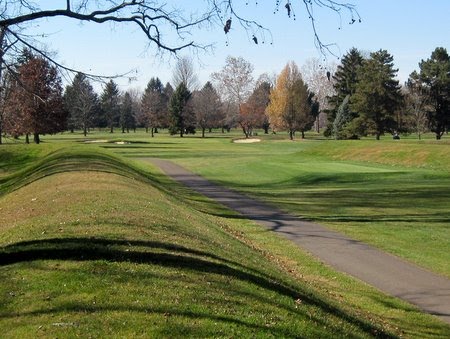
Was the mound with a tee on top of it originally flat topped or did the golf course designer do that?


That the golf course encompasses the Indian earthworks probably helps preserve them and the Ohio Historical Society now owns the land which it leases to the golf club. The historical society periodically closes the course and gives tours. In the great circle earthwork in the other part of town, the surrounding embankment is greater than the two mounds in the middle. Here all the mounds were bigger than the surrounding embankment which was about half the size of the great circle embankment.


Even without an overview, that is, just standing on top of one embankment, one can get a sense of a grand design, of vistas opening up in various direction with parallel walls of embankment guiding ones view and presumably ceremonial processions.


Beaver ponds are often built in a series of terraces following a stream. Beavers build canals that radiate from the pond allowing easier access to and transport of cut logs and branches. Beavers dredge these canals building up their banks. When drought dries up a pond, one can easily see, amidst a chaos of tree trunks, the channels and canals the beavers used when the pond was full. The beavers seem to have no concern for the heavens when fashioning this network, except to bring tall trees down to their level.


It would seem to make sense to have a lodge on the north shore so that it could be warmed by the morning sun in the winter, but I often see lodges in the shade on the south shore, lodges made by beaver families that struck me over the years as being rather sagacious survivors.


So it makes no sense crediting beavers for inspiring an observatory, but there were only two mammals here a thousand years ago making mounds with earth, humans and beavers. That said, we did notice that moles like to burrow their tunnels around some mounds. In Alabama we saw not a few ant hills on the plaza below the mounds. The leveling of the ground with loose soil probably attracted those animals.

By the end of my tour, I found myself missing the mystery and confusion of beavers ponds created by the chaos of beaver-cut trees. At this time of year especially beaver lodges themselves seem alive as beavers prepared them for the winter by loading on mud and logs. Beavers create a level of water which both reflects all above and supports another world below.


The Mound Builders leveled the ground and built mounds to dominate that ground. A beaver pond is too organic to have been the model for these magnificent ceremonial grounds of the Indians. So my working hypothesis that beavers were unimportant to Indians before the fur trade still holds despite my crazy desire to see the beavers' influence on everything grandly done in the days before they were sacrificed for European fashions.